
Why Due Diligence Matters More Than It Seems
Most corporate frauds do not occur because the victim was careless. They occur because they trusted superficial information: a well-designed presentation, unverified references, or an RFC that exists but does not correspond to what is declared in the actual transaction.
Counterparty due diligence is not distrust — it is the minimum standard of diligence that any serious operation must apply before committing relevant financial, technological, or human resources. In today's Mexican regulatory environment, signing without verifying can result in corporate criminal liability, severe tax contingencies, and irreversible assets loss.
Due Diligence Process Workflow
The following flowchart outlines the five sequential steps recommended for a comprehensive validation of a Mexican counterparty using open-source intelligence and corporate footprints:
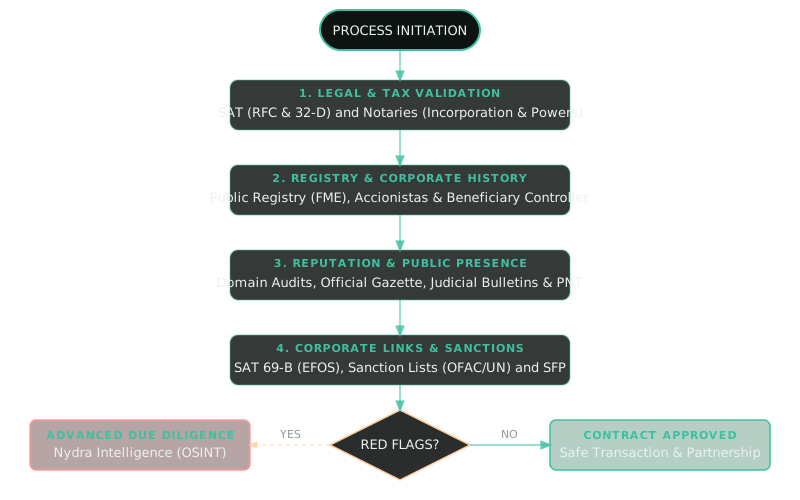
1. Legal Existence and Tax Status
The first step is to confirm that the entity exists and is active before the Mexican authorities.
- Active RFC in the SAT: Verify that the declared RFC corresponds exactly to the business name of the company. The SAT portal allows validating the RFC key directly to confirm if the taxpayer is registered as active, suspended, or cancelled.
- Incorporation Deed and Powers of Attorney: Request the full incorporation deed with its corresponding Public Registry stamp. Verify that the legal representative signing the agreement has a general power of attorney for lawsuits and collections, acts of administration, or acts of domain, and that it has not been revoked or limited in subsequent assemblies. A contract signed by someone without valid powers of attorney is legally void.
- Tax Compliance Opinion (32-D): The SAT issues this technical document reflecting whether the company is up to date with its current tax obligations. A negative opinion or refusal to provide it is an immediate red flag suggesting latent operational issues or shell structures.
2. Registry and Corporate History
Companies leave mandatory traces in public registers that allow reconstructing their real and historical corporate trajectory.
- Public Registry of Commerce (RPC): Using the SIGIGER system, you can consult the Electronic Mercantile Folio (FME) of the entity. This allows verifying bylaws, shareholders' assembly minutes, changes in ownership, capital increases of doubtful origin, and if there are commercial liens on assets or litigation affecting their equity.
- Changes in Corporate Name or Recent Mergers: A company that changed its mercantile name or restructured its capital right before establishing contact deserves a detailed audit. Often, fraudulent firms discard "burnt" corporate names or those with liabilities, and acquire clean shells to operate.
- Controlling Beneficiary: In accordance with the Federal Fiscal Code (CFF), since 2022 Mexican entities are required to maintain and update their controlling beneficiary information. In high-value transactions, demanding and verifying who actually controls the counterparty (the individuals behind the holding chains) is as crucial as knowing the company's name itself.
3. Public Presence and Verifiable Reputation
A company's digital footprint reveals qualitative information that formal or official documents usually omit or mask.
- Web Domain Age (WHOIS): A website registered three months ago for a company claiming ten years of experience in its commercial pitch is an incongruity that justifies suspending negotiations.
- Mentions in Media and Judicial Bulletins: Structured searches in local news databases, the Official Gazette of the Federation (DOF), and state and federal judicial bulletins reveal ongoing commercial, labor, civil, or tax litigation that was not disclosed during preliminary talks.
- Public Government Contracts: If a company boasts a high reputation built on prior government contracts, this claim is easily verifiable via search queries in the official CompraNet portal and the National Transparency Platform (PNT).
4. Corporate Links and Network of Relationships
A counterparty can be legally flawless on its own, and still represent a catastrophic risk if it is linked to individuals, partners, or companies with criminal or problematic regulatory histories.
- Partners and Administrators: The names of founding partners and board members must be cross-referenced against national and international sanctions lists (OFAC, UN lists, Interpol), as well as in public registries of politically exposed persons (PEPs) to rule out money laundering or corruption risks.
- Related Companies and Control Groups: The same administrator or minority shareholder can control a network of multiple inactive entities or those with identical addresses. Identifying and mapping this corporate network detects cross-cutting conflicts of interest, resource triangulation, and structures designed to evade liability in case of breach.
- List of Debarred Entities of the SFP: The Ministry of Public Function (SFP) publishes a registry of individuals and corporations sanctioned and disqualified from contracting with the federal government. This is critical if your company plans to subcontract the counterparty for public tenders.
Verification Sources & Public Tools Matrix
| Verification Module | Public Sources & Tools | Critical Data & Evidence to Extract |
|---|---|---|
| Legal & Tax | SAT Portal (RFC Validation), Form 32-D | RFC status validity, positive compliance opinion. |
| Corporate & Historical | Public Registry of Commerce (SIGIGER / FME) | Incorporation deed, representative's active powers, shareholders' meetings. |
| Reputation & Litigation | Judicial Bulletins (Federal/State), DOF, Transparency Platform | Existence of labor, commercial, or bankruptcy lawsuits, actual contracts. |
| Evasion Schemes & Sanctions | SAT 69-B List (EFOS), SFP Search, OFAC/UN Lists | Absence of simulated operations (invoice milling), sanctioned entities check. |
5. Red Flags Warranting Additional Investigation
The presence of any of the following behavior patterns must immediately pause the contract signing and trigger a deep open-source due diligence process:
- Suspicious Tax Address: The registered address corresponds to a low-cost virtual office, an abandoned residential site, or an address shared by dozens of unrelated companies.
- Notarial Discrepancy: The signing legal representative differs from the one appearing in the incorporation deed, and the representative power of attorney is recent, issued by a notary out of the state of origin, and the shareholder assembly minutes authorizing the appointment are not provided.
- Documentary Resistance: The counterparty shows unjustified resistance to providing basic corporate documents (like the Tax Situation Sheet or deed copies) under the pretext of confidentiality or NDA agreements.
- Incongruous Commercial Proposal: Conditions and prices significantly better than the market average without clear scale justification.
- Recent Incorporation: Entities incorporated less than twelve months ago seeking to formalize high-value or long-term operations.
What Makes Open-Source Analysis Different
A well-executed due diligence process does not depend on informal recommendation calls or subjective commercial references. It depends on cross-referencing structured and raw public information (mercantile registers, tax databases, judicial bulletins, corporate digital footprints) under a verifiable, documented, and source-traceable methodology.
The difference between a check-the-box superficial review and a professional open-source intelligence analysis is the difference between knowing that a company exists formally on paper and understanding exactly who you are really dealing with in operational reality.