
The rise of Financial Technology Institutions (fintechs) under Mexico's Fintech Law has optimized the speed of electronic transfers. However, their easy remote account setup has also made this sector the target of sophisticated social engineering and wire fraud campaigns. When a victim transfers funds under deception, the destination CLABE account usually points to a fintech processor.
"In digital fraud, time is the worst enemy. Technically documenting the financial trail within the first 72 hours is crucial for state prosecutors to issue urgent freezing orders."
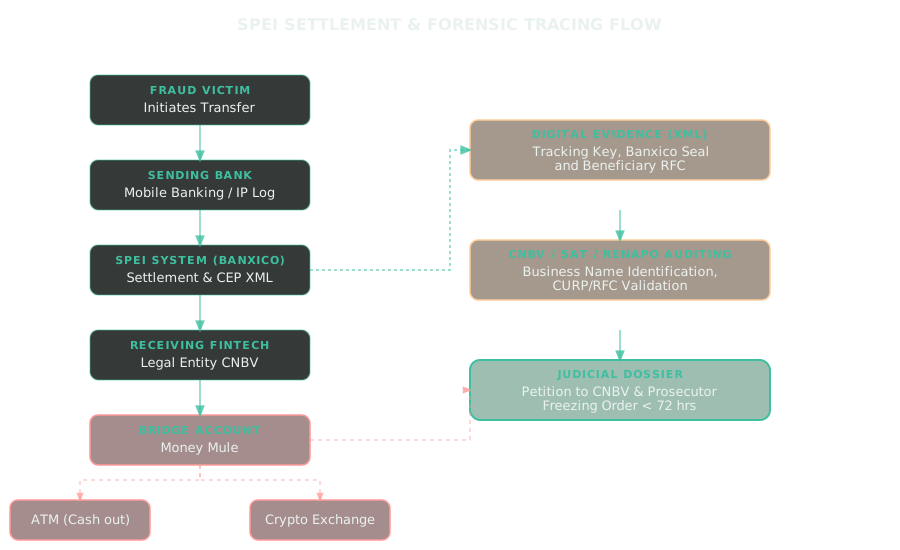
SPEI Settlement & Forensic Tracing Flow
The flowchart below illustrates the lifecycle of a fraudulent SPEI payment, from the victim's origin bank to the rapid outward cash-out channels used by attackers, highlighting the critical capture points for evidence:
1. Exploiting Banxico's Public Infrastructure (CEP)
Every transfer settled in the Interbank Electronic Payment System (SPEI) generates an Electronic Payment Receipt (CEP) issued by Banco de México (Banxico). Although the victim may only have the simplified receipt or screenshot from their banking app, the official CEP issued directly by Banxico's core infrastructure contains the metadata and digital signatures of forensic value essential to initiate legal action.
To download a CEP, you must access Banco de México's public query portal. The search requires entering the key payment details:
- Date of operation (Day/Month/Year)
- Tracking key (Clave de rastreo) or reference number
- Issuing institution (the victim's bank or fintech)
- Receiving institution (the destination fintech where funds were received)
- Beneficiary account (18-digit CLABE or debit card number)
- Exact transfer amount (with cents)
The downloaded file should ideally be in XML format, as it contains encrypted data digitally signed with Banxico's public key, giving it unalterable legal authenticity before any technology expert or trial judge.
Forensic Anatomy of the CEP XML
| XML Field (CEP) | Technical Description | Utility in Forensic Investigation |
|---|---|---|
| Tracking Key (Clave de Rastreo) | Unique alphanumeric identifier assigned by the sending institution for that specific transaction. | It is the primary key to interconnect the trace between the sending bank, Banxico, and the receiving fintech. |
| Beneficiary RFC | Federal Taxpayer Registry associated with the receiving account holder at the destination bank. | Enables an immediate cross-reference with the SAT and RENAPO to validate if the holder is real or suplanted. |
| Digital Seal (Signature) | Cryptographic signature of Banxico that seals the payment data guaranteeing its integrity. | Serves as non-repudiation digital proof valid in oral trials to link the receiving fintech. |
| Amount & Settlement Time | Exact amount transferred and precise timestamp (hours, minutes, seconds) of the settlement. | Establishes the exact time window to request ATM camera footage and network logs (IPs). |
2. Attribution to the Receiving Fintech Entity
The commercial name visible to the victim in their bank app (e.g., "Nu", "Mercado Pago", "Spin by OXXO") often differs substantially from the legal name of the regulated entity registered with the National Banking and Securities Commission (CNBV) that must be legally subpoenaed.
The Financial System Directory (CASF) managed by the CNBV is public. By entering the first three digits of the destination CLABE or the receiving bank's short code from the CEP (e.g., STP, NVIO, SPIN), it is possible to extract the exact corporate name and the legal address for serving official requests. This avoids sending requests to merchant payment processors who lack custody of financial data.
3. Cross-Referencing and Identifying Fake Identities
In a high percentage of digital fraud cases, the receiving account holder is a "money mule" recruited by criminal groups, or a person whose identity was stolen using IDs bought in dark markets.
If the CEP provides the beneficiary's RFC with its full homoclave, this record must be validated in the SAT's official portal to check its validity and if the associated CURP exists. The CURP, in turn, allows a query in the National Population Registry (RENAPO). This cross-check confirms the authenticity of the holder's name, state of registry, and birth date, determining if the subject is real or if we are dealing with a synthetic (fake) identity profile.
4. Structuring the Forensic Dossier for Judicial Authorities
Asset tracing in Banxico and CNBV open sources culminates in structuring the investigation dossier. For the prosecutor or judge to order measures quickly, the request must be written with surgical technical precision:
- Direct Order to CNBV / General Directorate of Attention to Authorities: Requesting to urgently order the receiving fintech to reveal the complete KYC (Know Your Customer) onboarding file: scanned ID, selfie/facial biometric validation photo, IP address and GPS coordinates used during registration, and the phone number registered for OTP verification.
- Traceability of the Outward Flow: Demanding the detailed history of transfers (withdrawals) following the deposit. In fast-laundering schemes, funds are split into bridge accounts, withdrawn in cash at ATMs, or moved to crypto exchanges in less than 15 minutes after arrival.
Conclusion
The SPEI system is neither anonymous nor opaque. By downloading the digital CEP in XML format, mapping the CNBV catalog, and validating the identities involved (SAT/RENAPO), legal, corporate, and cybersecurity teams can build a technically solid and unalterable investigation report in a few hours. Speed in structuring the forensically sound dossier is the critical factor for asset recovery and disrupting the attacker's cash-out channels.